


What makes a good game for kids? How we design ours
Updated October 23, 20264 min read
No lives to lose, no timers that punish, no strangers to talk to. Here is what we look for in a children's game, how we build it into ours, and which of our games suit which ages.
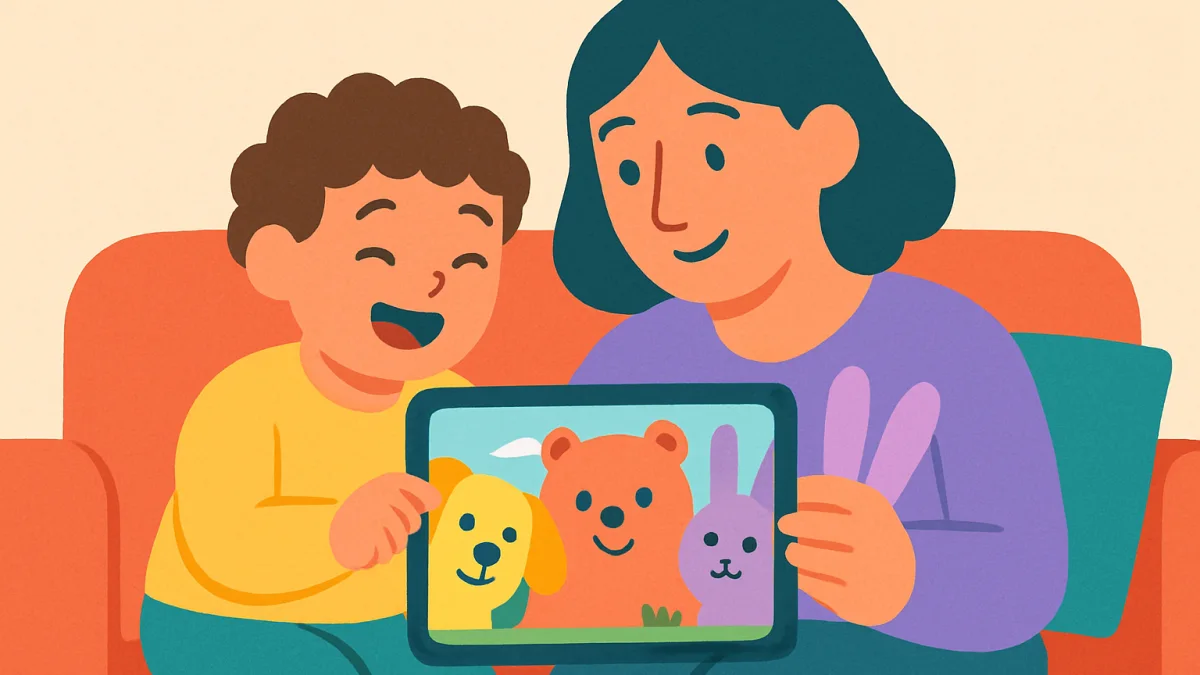
Many of our games are made for children, and some for very young children. Parents often ask what "for kids" means on a site that also has racing and arena games. The short answer is that our kids' games follow a small set of rules we never break. The long answer is this article.
Rule one: nothing to lose
The youngest players do not enjoy failing, and they should not have to. In Fluffy Doc there are no mistakes and no time limit: you cannot treat the kitten wrong, you can only take longer. In Dabbleberry, the colouring book, the brush never goes outside the lines, so every picture looks good. Where a game does have a clock, like the stars in Pieceberry Jigsaw, it only adds a reward; nothing is taken away when it runs out.
Rule two: a hand that shows the way
Text is useless for a four-year-old. Our games for the youngest show a little hand that points at the next thing to do: the sponge, the thorn, the oven dial. The hand appears after a few seconds of nothing happening and goes away as soon as the child touches the right thing. Older children never see it, because they never pause long enough.
Rule three: nobody to talk to
None of our games have chat, friend lists or messages between players. Where a game has other characters, they are computer players with names and faces we drew. Two-player games happen on the same device, with a sibling or a parent on the other half of the keyboard or screen. This is the reason we did not add online multiplayer to our children's games, and we are not planning to.
Rule four: nothing to buy
Coins, stars and gems in our games are earned by playing and spent inside the game on hats, colours and decorations. There is no shop with real money, no "watch an ad to continue", no energy that runs out. The sites are funded by advertising shown around the game, according to the cookie choices made in the browser, and never inside the game itself.
Rule five: gentle, not boring
Gentle difficulty does not mean no difficulty. Make Pizza! gets busier over ten days, and taking the pizza out of the oven at exactly the right moment is a real skill. Cluckleberry, the farm, has dozens of recipes and buildings to unlock. The challenge grows with the child; what we avoid is the sudden wall that ends the fun.
Which game for which age
- 3 to 5: Dabbleberry (colouring), Fluffy Doc (animal clinic), Pieceberry Jigsaw with 12 or 24 pieces, Bobbertide (fishing with an otter).
- 5 to 7: Make Pizza!, Pieceberry Jigsaw with 35 to 54 pieces, Cluckleberry, and the Mini 6×6 mode of our sudoku.
- 7 to 10: Cluckleberry in full, the quest mode of Cubbycraft, the two-player board games, and the easy cups of our racing games.
These are suggestions, not locks. A seven-year-old who loves colouring should keep colouring.
What we ask of parents
Play the first few minutes together. Our games explain themselves to children, but a parent who knows where the pause button is and what the stars mean answers questions faster than any tutorial. And if something is wrong, a word that is too hard, a button that is too small, the Report button under every game goes straight to us. We read every one.
Where the games run
Everything plays in the browser, on a tablet, a phone or a computer, with no download and no account. Progress is saved on the device, so the same tablet shows the same gallery of finished pictures tomorrow. If you would like the games on a phone's home screen, our guide to playing on a phone explains how in two steps.