

How we make a game: from a sketch to a release on :site
Updated October 23, 20264 min read
A new game on the site is a few weeks of work by a small team. Here is the whole path, from the first sketch to the eight languages, the testing on old phones and the morning it goes live.
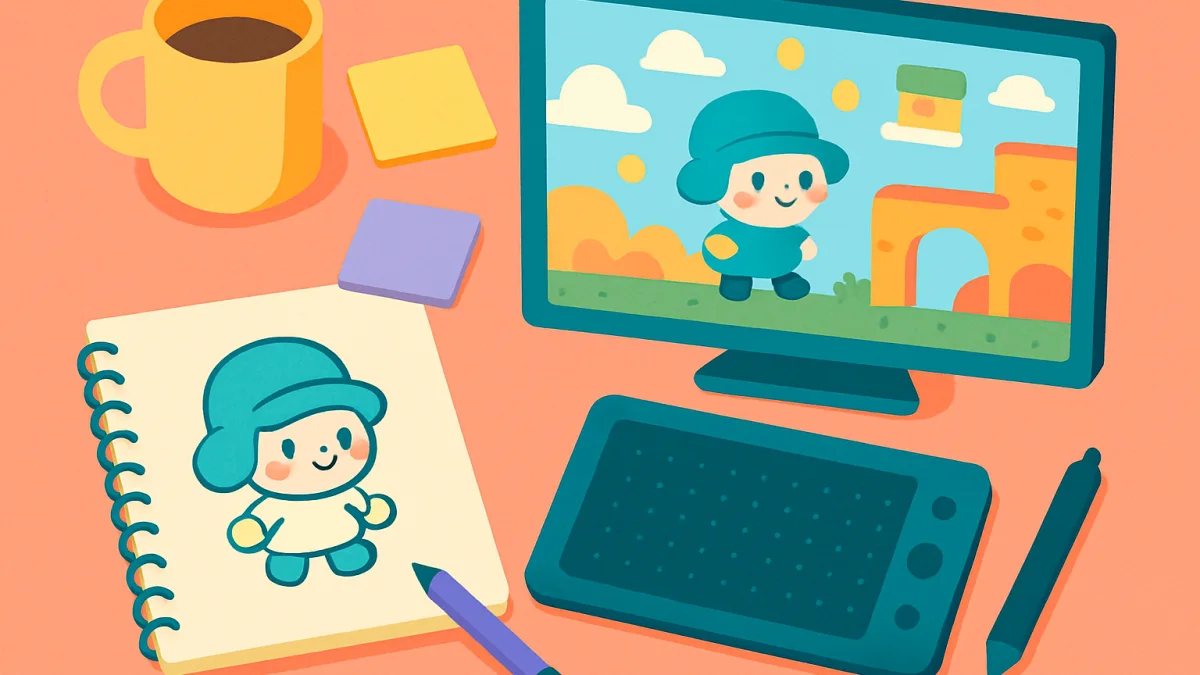
People sometimes assume a site with dozens of games must buy them in bulk. We make ours, one at a time, and a new game takes a few weeks from the first sketch to the morning it appears in the What's new list. This is what those weeks look like.
Week one: the idea and the question
Every game starts with one question: what does the player do with their hands for ten minutes, and why is that fun? "A racing game" is not an answer. "Hold a button in a corner and release it at the right colour" is. For Wicky Quest the answer was "a candle that is afraid of water and loves lava", which gave us the whole level design before a single platform was drawn. If we cannot answer the question in one sentence, we do not start.
The second filter is who the game is for. We make games for families, so anything with blood, guns or chat is out before it begins. Robots in Gooshot Gus pop into confetti; nobody in any of our games gets hurt.
Week two: the ugly prototype
The first version is grey boxes. A square that jumps, a circle that rolls, numbers on the screen. No art, no sound, no menus. The only thing we test is whether the one-sentence answer holds up: is holding the drift button for pink actually fun, or does it just feel like waiting? About a third of our prototypes stop here, and that is the cheapest place to stop.
The prototype also decides the controls. Every game must work with a keyboard, with touch and, where it makes sense, with a gamepad, and the touch version is designed first, because it is the hardest to get right. If a game needs more than two thumbs, it is redesigned.
Weeks three and four: art, sound and feel
Once the grey boxes are fun, the art starts. We draw our own characters and scenes in a consistent style, soft and bright, because we want a player to recognise a game of ours from a thumbnail. 3D games get low-poly models for the same reason, and because they load fast on phones. Sound comes next, and it is where a game starts to feel alive: the pop of a bubble, the click of pool balls, the splash in Bobbertide when the fish bites.
"Feel" is the invisible part: how long a jump hangs in the air, how much the screen shakes on a hit, how quickly a menu answers a tap. We spend more time here than anywhere else, and it is the part nobody notices when it is right.
Week five: words, in eight languages
Every text in the game, from the title to the hint on level 23, exists in English, Romanian, Spanish, French, Italian, German, Portuguese and Turkish. Word games like Letterloons and Glowbug Words go further and have separate word lists per language, with the right alphabet. The game page gets a description, instructions, tips and a few questions and answers in each language too, written for people, not for search engines, although search engines seem to like them as well.
Week six: testing on real devices
A game that runs on our computers is not finished. It is tested on a five-year-old Android phone, on a cheap tablet, on an iPhone, on a laptop with an integrated graphics chip and on a desktop with a gamepad. The old phone finds most of the problems: a 3D game that drops frames, a button too small for a thumb, a sound that does not start. We lower the graphics automatically on weak devices rather than asking the player to.
Then it goes to the toughest testers we have, children aged four to ten, who do not read instructions and press everything. If they are stuck, the game is wrong, not the child, and we change it.
Release day
Publishing is one command that uploads the game, its thumbnails and its texts in all languages to the site. The game appears in its categories, in the new games list and in the catalogue, and a short clip goes to our social accounts. The first days bring the reports: the Report a problem button under each game reaches us directly, and the first update usually ships within a week.
After release
A game is never quite finished. Moon Muffins had two trophies added because players asked, Vroomble got a daily race, and several games gained colour-blind options after a single message. If there is something you would change in one of our games, say so. The contact page is in the footer, and it goes to the people who made the game.