


Sudoku for beginners: the five techniques that solve most puzzles
Updated October 23, 20264 min read
Scanning, hidden singles, naked pairs, the rule of 45 and when to use notes. The techniques that take you from Easy to Hard in Ninelight Sudoku, explained in plain words with no maths.
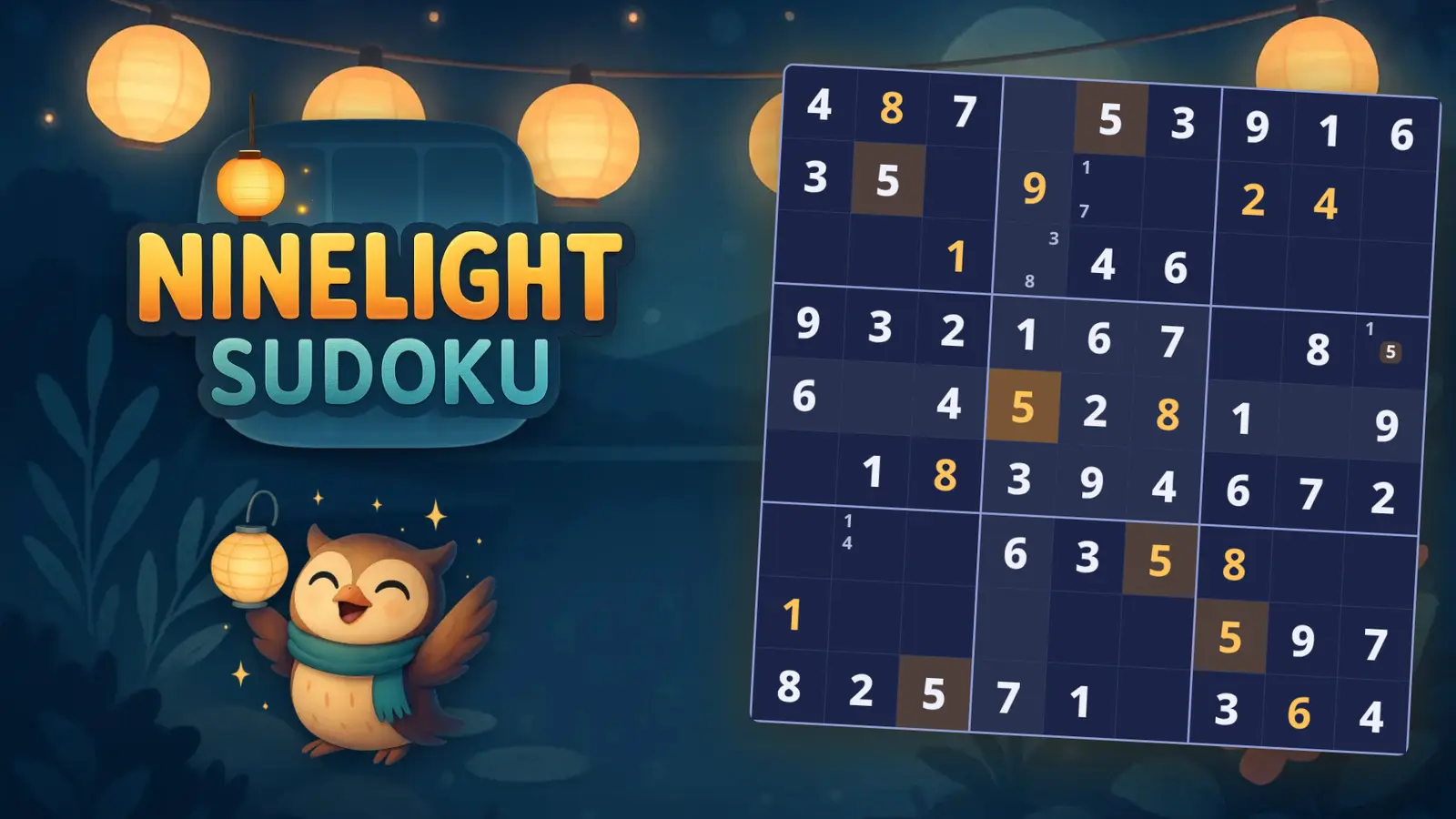
Sudoku has one rule: every row, column and 3×3 box holds each number from 1 to 9 exactly once. Easy puzzles can be solved by looking; harder ones need a few named techniques. The good news is that five of them solve almost everything up to Hard, and Ninelight Sudoku grades its puzzles by exactly these techniques, so you always know which one a level expects.
1. Scanning
Pick the number that already appears most often on the grid. Follow it through the rows and columns: every row and column that contains it cannot contain it again, so in each box the number is restricted to the cells not crossed by those lines. When only one cell in a box remains, write it in. Then take the next most common number. Scanning alone solves most Easy puzzles.
2. Hidden singles
A hidden single is a cell where a number can go in only one place within a unit (row, column or box), even if that cell could hold other numbers too. Scanning finds hidden singles in boxes; do the same for rows and columns. Ask, for each row: where can the 7 go? If the answer is one cell, that cell is a 7, whatever else looked possible.
3. Naked singles and notes
A naked single is a cell that can hold only one number, because the other eight are already in its row, column or box. These are easy to miss by eye and trivial with notes. From Medium upwards, switch on Notes, or use Auto notes to fill every cell with its candidates: a cell with a single candidate is a naked single, and the puzzle will show you several at once.
4. Naked pairs
When two cells in the same unit can only hold the same two numbers, say 3 and 8, then those two cells will hold 3 and 8 in some order, and 3 and 8 can be removed from every other cell of that unit. This often turns a cell with three candidates into a naked single. The same idea works with three cells and three numbers (a triple), but pairs alone carry you through most Hard puzzles.
5. Pointing pairs
If, inside a box, a number can only go in two cells that happen to be in the same row, then that number must be in that row inside that box, and can be removed from the rest of the row outside the box. It sounds small, and it is often the only move available on a Hard puzzle. Look for it when the other techniques stall.
Beyond Hard: let the owl teach you
Expert and Extreme puzzles need X-Wings, Swordfish and wings. You can read about them, but the fastest way to learn is the hint system: the owl first shows where to look, then explains the technique in words, and only applies it when you press Apply. Pressing Hint on a puzzle you are stuck on, reading, and then undoing the Apply to do it yourself is the best sudoku lesson there is.
Killer Sudoku and the rule of 45
In Killer Sudoku, cells are grouped into dashed cages with a sum, and numbers never repeat within a cage. Learn the forced cages first: two cells adding to 3 are 1 and 2; two cells adding to 17 are 8 and 9; three cells adding to 6 are 1, 2 and 3. Then use the rule of 45: every row, column and box adds up to 45. If a box contains cages totalling 40 plus one cell outside those cages, that cell is 5.
Diagonal Sudoku
Both long diagonals must also contain every number. Treat them as two extra units to scan. The centre cell lies on both diagonals, its row, its column and its box, so it is the most constrained cell in the grid and often the first you can solve.
Mini 6×6
Mini sudoku uses the numbers 1 to 6 and 2×3 boxes. The techniques are the same, the grid is smaller, and it is the right place for children and for anyone who finds a 9×9 intimidating. A Mini puzzle takes a few minutes and teaches scanning perfectly.
Three stars, Check and Reveal
Three stars means no mistakes and no hints. Check only tells you whether your numbers so far are right and does not count as a hint; Reveal fills a cell and does. The optional limit of three mistakes is a good training setting, because it stops you guessing.
Quick checklist
- Scan the most frequent number first.
- Ask "where can the 7 go?" for every row, column and box.
- Notes on from Medium; look for single-candidate cells.
- Pairs remove candidates from the rest of the unit.
- Stuck? Hint, read, undo, redo it yourself.
Ninelight Sudoku has thousands of hand-checked puzzles with exactly one solution each, a daily challenge and full keyboard control, and it runs in the browser on any device. More puzzle games are one click away.